

How to Create and Manage Invoices
Step-by-step guide to create, email, and track construction invoices for your projects
What This Feature Does
The invoicing system helps you create professional invoices for your construction projects, track payments, and manage billing for clients and subcontractors.
Initial Setup
First-Time Configuration
- Navigate to "Invoices" by clicking "Invoices" in the left sidebar
- You'll see the invoices dashboard with any existing invoices
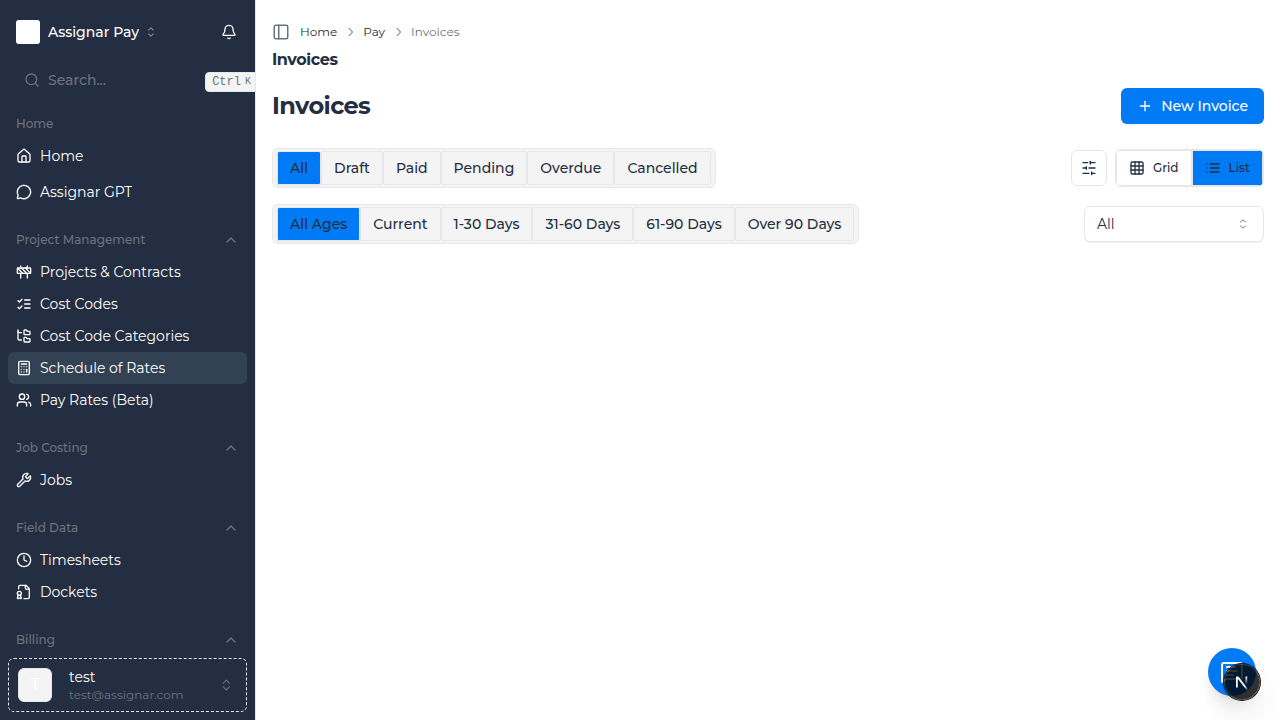
- To create your first invoice, click the "New Invoice" button in the top right corner
Required Information
Before you begin, make sure you have:
- Client information set up in your projects
- Project details configured
- Your company banking details for payment instructions
- Line items or timesheets to bill
Invoice Email Settings
Configure defaults for invoice emails under team invoice settings.
- Go to Settings in the left sidebar
- Open Invoice Settings
- Under Email settings:
- Reply-to: Optional address clients use when they reply (falls back to your company email if blank)
- Always CC: Internal addresses copied on every invoice email (comma-separated)
- Default subject and Default message: Prefill the send dialog
- Click Save
How the From address works: Invoices are sent from Assignar Pay on your behalf — for example "Acme Construction via Assignar Pay" <noreply@assignar.com>. Clients reply to your reply-to (or company) address. Emailing an invoice does not change the invoice status (Draft / Pending / Paid, etc.).
Day-to-Day Usage
How to Create a New Invoice
- Go to "Invoices" in the left sidebar
- Click "New Invoice" button in the top right corner
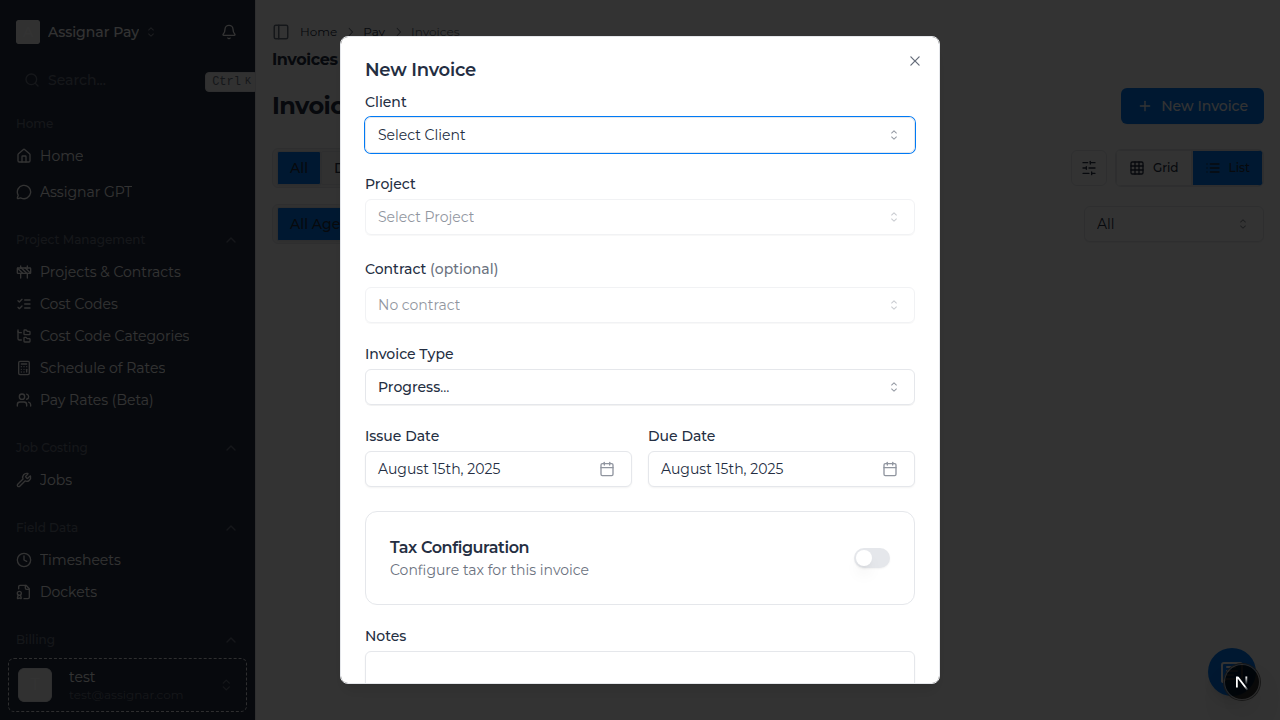
- Fill in the invoice details:
- Invoice Type: Select "Standard", "Progress Claim", or "Final Invoice"
- Client: Choose the client you're billing
- Project: Select the relevant construction project
- Invoice Date: Enter today's date or the billing date
- Due Date: Set when payment is due (typically 30 days)
- Add invoice line items:
- Click "Add Line Item"
- Enter Description: e.g., "Concrete foundation work - Week 1"
- Enter Quantity: Hours worked or units completed
- Enter Rate: Your hourly rate or unit price
- The system will automatically calculate the subtotal
- Review payment details section (your bank details are pre-filled)
- Add any Notes for the client (e.g., "Payment due within 30 days")
- Click "Save Invoice" to create as draft, or "Send Invoice" to send immediately
How to Track Invoice Status
Invoices move through these statuses. Change an invoice's status with the Update Status button on the invoice detail page.
- Draft: being prepared — you can still add, edit, remove, and re-group line items
- Pending: finalized and issued to the client, awaiting payment. A draft becomes Pending when you issue it — this is the "issued" state; there is no separate "Sent" status
- Paid: payment received
- Overdue: past the due date and unpaid
- Cancelled: voided. Cancelling releases the timesheets, dockets, and materials the invoice billed so they become available to invoice again
Allowed moves: a Draft can only go to Pending or Cancelled; a Pending invoice can go to Paid, Overdue, or Cancelled. An invoice cannot go back to Draft once it has been finalized. Use the status filter on the invoices list to view each group, and click any invoice to open its details.
How to Finalize and Send an Invoice
- Open your draft invoice and review the line items, grouping, and totals
- Click Update Status and choose Pending to finalize/issue it. This is the point the invoice is locked: its line items and the rates of the timesheets/dockets/materials it billed can no longer be edited (see "Editing rates after an invoice is finalized")
- Email or download the invoice as a PDF to deliver it to the client (see below). You can also select invoices in the list and email them in bulk
How to Email a Single Invoice
- Open the invoice detail page
- Click Send by email
- In the dialog, confirm or edit To, CC, Subject, and Message
- Click Send
The invoice PDF is attached automatically. Delivery runs in the background; you get an in-app notification when it finishes or if it fails. Invoice status is unchanged by the email.
How to Email Invoices in Bulk
- Go to the invoices list
- Select one or more invoices with the checkboxes
- Choose the bulk Send by email action
- Review the dialog:
- Eligible invoices are queued for send
- Invoices that cannot be emailed (for example missing a client email and no override) are listed as skipped
- Confirm to queue the sends
Bulk send continues past individual failures. You will get a summary notification of how many succeeded and how many failed. Open a failed invoice and use Send by email to retry.
How to View Invoice Email History
On the invoice detail page, the Email history (or send history) card lists each send attempt for that invoice:
- When it was sent (or failed)
- Recipients
- Status
- A link to download the PDF that was attached for successful sends
Use this to confirm delivery and re-download the exact PDF that went to the client.
How to Edit an Invoice
You can change a draft invoice freely from its detail page. (Once it's Pending/finalized, editing is locked.)
- Add or remove line items — use the Add from… buttons or Add Item to add, or the trash icon on a line to remove.
- Edit line items — click Edit Line Items to change the description, cost code, quantity, and unit price for every line in one save (details under Common Tasks below).
- Change how lines are grouped — use the Group by dropdown on the invoice.
Grouping is now chosen on the invoice with Group by — it is no longer chosen while adding from timesheets, dockets, or materials. The Add flow always brings work in as detailed lines (one per charge rate); you then group them however you like on the invoice, and that grouping is what prints and emails.
Common Tasks
Creating a Progress Claim Invoice
- Navigate to "Invoices" and click "New Invoice"
- Select Invoice Type: "Progress Claim"
- Choose your Client and Project
- In the line items section:
- Add each completed work package
- Enter percentage complete (e.g., "Foundation work - 75% complete")
- Enter the value for this progress period
- Reference any approved variations or change orders
- Click "Save Invoice" to prepare for client review
Adding Line Items from Your Data (timesheets, dockets, materials)
On a draft invoice's detail page, use the buttons above the line items table to pull costed work in as line items:
- Add from Worker And Equipment Time — costed timesheets (labour + equipment). Each charge rate becomes its own line, priced from the matched Schedule of Rates (e.g. an 8 h normal-time line and a 2 h double-time line from the same shift).
- Add from Dockets — costed dockets, per worker.
- Add from Materials — costed material transactions.
- Add Item — a manual line where you type your own description, quantity, and unit price.
Only transactions that have been rate-costed and are not already fully invoiced appear in the pickers. A timesheet or material can be partially billed across more than one invoice — the picker shows the remaining amount still available to bill.
Editing Line Items After Adding Them (Edit Line Items)
On a draft invoice, click Edit Line Items to edit every line in one screen and save together:
- Description and Cost Code on any line
- Quantity and Unit Price on manual lines and on lines that came from a timesheet, docket, or material
When you change the quantity, unit price, or cost code of a line that came from a transaction, the change is written back to that transaction's rate calculation, so the timesheet/docket/material's "Rate Calculation Details" stays in sync with the invoice. (Manual lines have no source transaction, so they only update the invoice line.)
Grouping Line Items (Group by)
On a draft invoice, the Group by dropdown controls how line items are displayed — and how they print:
- Detailed — every charge rate as its own line
- By Description — merge identical descriptions
- By Rate Type — group by rate type (e.g. normal vs overtime)
- By Worker — one group per worker (useful for docket invoices)
- Summary — a single summarised line
You set this on the invoice (not while adding line items — the Add flow always brings in detailed lines), and the choice is saved on the invoice, so the downloaded PDF and the emailed copy match exactly what you see on screen.
Editing Rates After an Invoice Is Finalized
Once an invoice is Pending (finalized), the rates of the timesheets, dockets, and materials it billed are locked so an issued invoice can't be changed underneath the client:
- Edit Line Items and the Group by selector are only available on draft invoices.
- On Schedule of Rates > Transactions, the Edit Rates button for a transaction that's on a finalized invoice is disabled, with a tooltip explaining it must be edited from the invoice.
To change a rate that's already on a finalized invoice, cancel that invoice (which releases its transactions back to billable) and re-invoice, or make the change on a draft invoice that bills it.
Setting Up Automatic Invoice Numbering
- Go to "Settings" in the left sidebar
- Click "Invoice Settings" tab
- Under "Invoice Numbering":
- Prefix: Enter your company code (e.g., "ABC-")
- Starting Number: Set your first invoice number
- Format: Choose date format if desired (e.g., "ABC-2024-001")
- Click "Save Settings"
- All new invoices will use this numbering system
Common Tasks for Construction Teams
Creating Invoices for Subcontractors
- Set up the subcontractor as a "Client" in your projects
- Create an invoice selecting this subcontractor client
- Add line items for:
- Materials supplied
- Labor provided
- Equipment rental
- Any approved variations
- Include reference to purchase orders or contracts
- Send invoice with payment terms
Managing Retention Invoices
- Create a new invoice for the client
- In line items, add:
- Description: "Retention release - [Project Name]"
- Amount: The retention amount being released
- Reference: Original invoice numbers
- Include any defects list or completion certificates
- Set appropriate due date (often longer for retention)
Troubleshooting
If you can't see the "New Invoice" button
- Check that you have "Invoices" permission in your role
- Ensure your team subscription includes invoicing features
- Contact your team administrator for access
If invoice emails aren't being received
- Check the client's email address is correct in the send dialog (and on the client record)
- Verify Reply-to, Always CC, and defaults under Settings → Invoice Settings
- Check the client's spam/junk folder
- Open the invoice and check Email history for a failed send, then retry with Send by email
- Try sending a test invoice to yourself first
If calculations seem incorrect
- Verify tax rates are set correctly in settings
- Check that pay rates match your agreements
- Ensure timesheet data is approved before importing
- Review any manual adjustments made to line items
Tips for Construction Teams
- Use consistent descriptions that reference specific work packages or locations
- Include photo documentation or progress reports with progress claims
- Set up templates for recurring invoice types (materials, labor, equipment)
- Send invoices promptly after milestone completion to maintain cash flow
- Track which invoices include retention amounts for end-of-project release
What's Next
After setting up invoicing, you may want to:
- Set up Pay Rates for accurate labor costing
- Connect Timesheets for automated billing