

How to Manage Team Members
Step-by-step guide to invite, manage, and assign roles to team members in your construction organization
Workspace membership decides who can sign in to your organization in Assignar Pay and how much of it they see. You manage it on Resources → Users, on the Members tab.
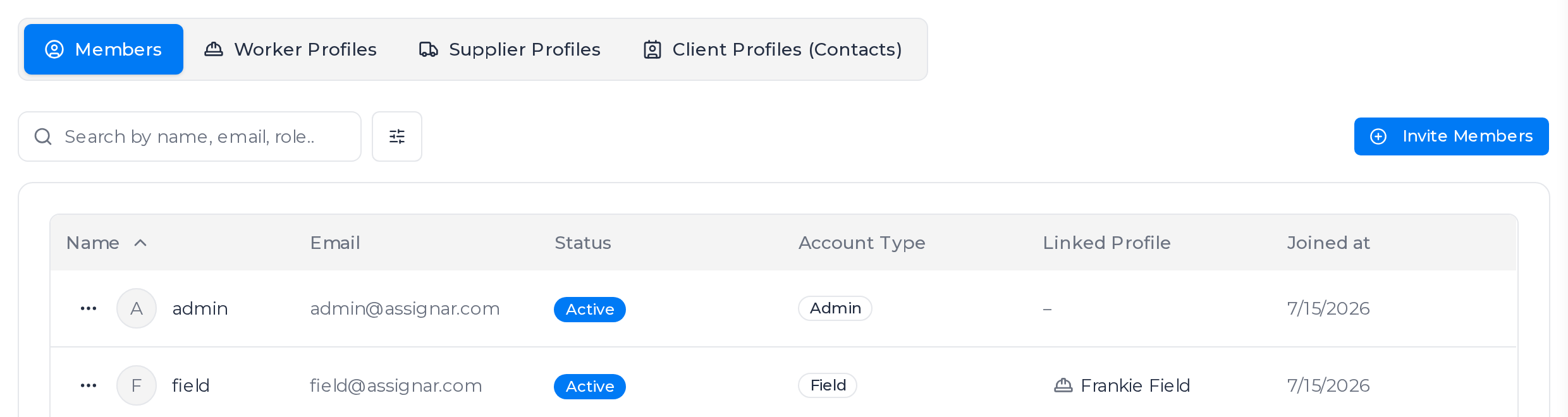
Membership is not the same thing as Resources → Roles. Those are worker roles used on timesheets and pay — Laborer, Operator, and so on. So are the other tabs on Users: Worker Profiles, Supplier Profiles, and Client Profiles (Contacts) hold payroll and contact records, not sign-ins. A person can have both a membership and a worker profile.
Invite someone to your organization
- Go to Resources → Users and open the Members tab.
- Click Invite Members.
- Enter the person's email address and pick a Role.
- Click Add another one for each extra person — five per invite.
- Click Send Invites.
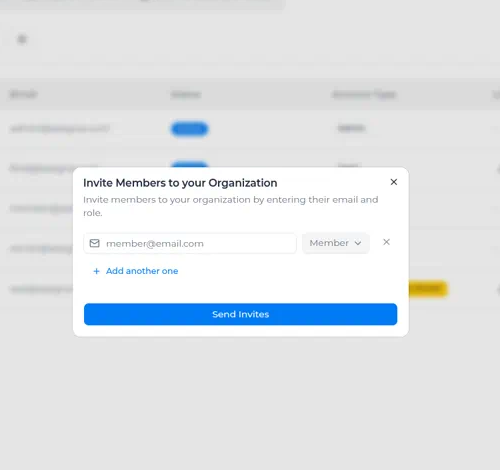
Each person gets an email invitation. Their row appears straight away with Status set to Pending invite, and flips to Active once they accept.
Which role to give someone
The Role list offers Owner, Admin, Manager, Field, and Visitor. You can only choose a role at or below your own, so an Admin cannot create an Owner. To grant someone a curated subset of Admin or Manager rather than the full role, apply an Access Preset from their access editor after they join.
Field is the role for on-site workers. A Field user sees only their own shifts, timesheets, and assigned work, and gets a cut-down sidebar to match.
Customer and Supplier are not on this list. You give those people access from Client Profiles (Contacts) and Supplier Profiles instead.
For what each role can actually open, see Roles and Permissions.
Give an existing worker a login
A worker profile is a payroll record — on its own it doesn't let anyone sign in. When a worker you already have on file needs access, invite them from their profile rather than from Members, so the login and the payroll record end up attached to each other.
- Open the Worker Profiles tab and find the worker. They need an email address on their profile.
- Use the row's Invite / Link action to open Give this worker access to Assignar Pay.
- Stay on Invite to send them a new invitation — the role defaults to Field. Switch to Link to existing account if they already have a membership you want to attach.
Their Linked Profile on the Members tab then points back to the worker record.
Change a role, renew an invite, or remove someone
The Members table shows Name, Email, Status, Account Type, Linked Profile, and Joined at. Use the search box — Search by name, email, role... — to narrow a long list. Linked Profile links through to the worker or supplier profile attached to that person, and is blank for anyone with neither.
Open the actions menu at the end of a row. What you see depends on whether the person has accepted.
For an active member:
- Update Role opens Update Member's Role. Pick a different role and click Update Role.
- Remove from Account — confirm with Remove User from Organization.
- Transfer Ownership — only the primary owner sees this.
For a pending invitation:
- Update Invitation changes the role before the person accepts. To fix a wrong email address, remove the invitation and send a new one.
- Renew Invitation appears once Status reads Expired.
- Remove Invitation withdraws it.
Memberships have no end date, so remove people yourself when they leave the company or finish on site.
Limit someone to specific projects
If your organization has the Subcontractor Hub, you can limit a member to the projects they actually work on. The Projects column on the Members table shows where each person stands:
- All — the default. This person sees every project in the organization.
- 3 projects — this person is limited to three projects. Open Project access on their row to see which.
- All (admin) — Owners and Admins are never limited, and cannot be.
Open the actions menu on the row and choose Project access. Tick the projects the person should see, or choose All projects to remove every limit and put them back to seeing everything. Save.
You can also work the other way round. Open a project, go to its Subcontractors tab, and use Project access there to see who is limited to that project and add or remove people. That list is who is limited to the project — everyone who is not limited at all can already open it, so an empty list means "nobody is restricted to this project", not "nobody can see it".
What project access covers today. It limits the Projects list, the project selector in the navigation, and the Subcontractor Hub screens. It does not yet restrict timesheets, orders, forms, or reports — someone limited to one project can still reach those. Broader row-level restrictions are separate work.
A few rules worth knowing before you use it:
- You cannot limit yourself, the primary owner, an Owner, or an Admin.
- Deleting the last project someone was limited to puts them back to seeing everything. If that happens, their Projects list shows a notice saying so — reopen Project access and give them a live project.
- Changes take effect immediately and are recorded in the organization's history.
Switch your workspace to one project
If your organization has the Subcontractor Hub, and you are an Owner, Admin or Manager who can reach more than one project, you see a project picker in the navigation, above the menu. It offers All projects plus each project you can open.
Choosing a project narrows the Projects list to the client that owns that project, and shows the project's name as a badge in the page header. That client's other projects stay visible underneath it — the picker narrows the list, it does not hide individual projects. The choice sticks per organization and survives signing out and back in. It is a view preference, not a permission: it changes what you are shown, never what you are allowed to open.
If you can reach exactly one project, there is no picker: that project is simply your workspace.
When an invite or a role change fails
You do not have permission to invite members. Your role cannot manage invitations. Ask an Owner or Admin to send it.
You cannot invite members with the "admin" role. You picked a role above your own — the message names the role you chose. Pick a lower one, or ask an Owner to send the invite.
Role is the same as the current one. Update Role needs a different role than the member already has.
Sorry, we couldn't update the role of the selected member. or Sorry, we couldn't remove the selected member. The change did not save. Try again.
Invite not found or expired — this is what the invited person sees when they open a dead link. Find their row, check that Status reads Expired, and use Renew Invitation.
If someone signs in but cannot open a feature, check two things on their row: Status must be Active, not Pending invite, and Account Type must be the role you meant to give them.